


Syllabus Outline
Assessment Details
-
Section
Description
-
Paper 1
(36%)Multiple choice questions
Four data-based questions related to experimental work and the syllabus
-
Paper 2
(44%)Data-based question
Short-answer questions related to the syllabus
Extended-response questions
-
IA (20%)
A 3000-word report based on a 10 hour scientific investigation
Course Comparison
-
Level
Description
-
Standard
Length: 150 hours (110 hr content + 40 hr practical work)
Paper 1: 55 marks (30 multiple-choice + 4 data-based questions)
Paper 2: 50 marks (one of two extended responses attempted)
-
Higher
Length: 240 hours (180 hr content + 60 hr practical work)
Paper 1: 75 marks (40 multiple-choice + 4 data-based questions)
Paper 2: 80 marks (two of three extended responses attempted)
Syllabus Structure
The IB Biology syllabus has been structured according to four themes that have been further divided into four levels of organisation:
-
Themes: Unity and Diversity, Form and Function, Interactions and Interdependencies, Continuity and Change
-
Layers: Molecules, Cells, Organisms, Ecosystems (increasing in complexity)
While the use of themes is helpful for making connections between different topics, there are a number of limitations with this model:
-
Certain concepts that are closely related may become disconnected across themes (e.g. evolution in A4.1 and natural selection in D4.1)
-
Higher level content is intrinsically embedded in the themes, making it difficult to teach separately from the standard level content
For this reason, the syllabus has been reorganised into a traditional topics format (with all higher level content organised into discrete topics)
-
Topics: Biomolecules, Cells, Metabolism, Genetics, Heredity, Equilibrium, Body Systems, Plant Systems, Biodiversity, Nutrition, Ecology, Human Impacts
Themes vs Topics
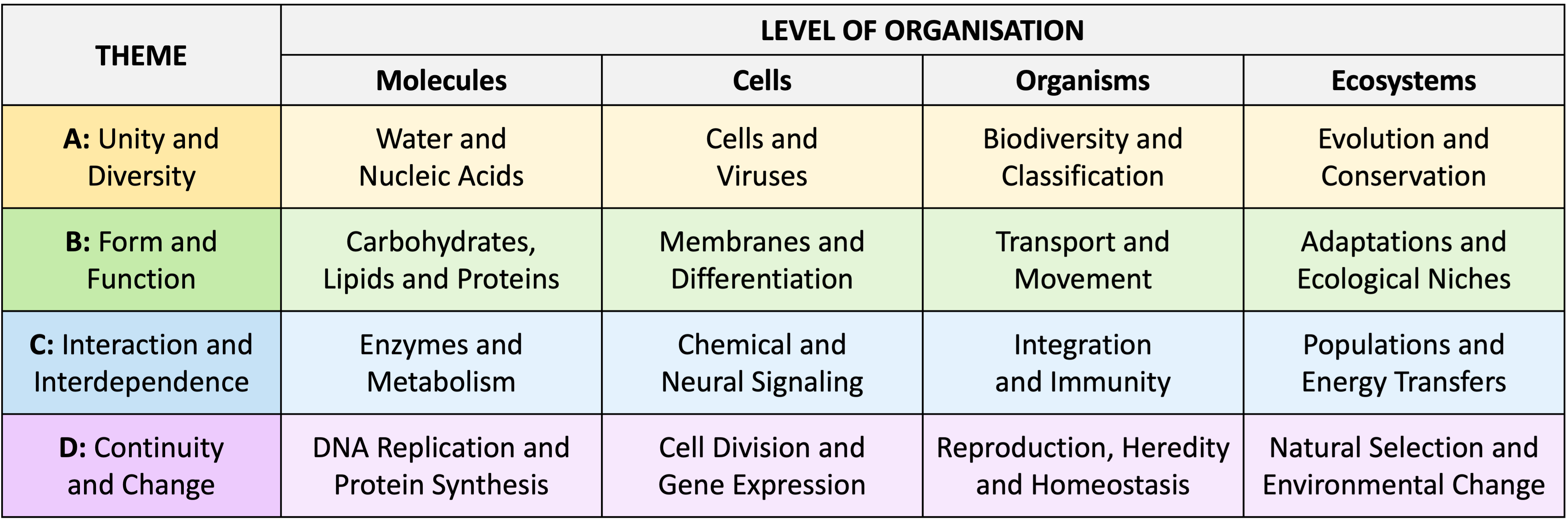
Themes Syllabus
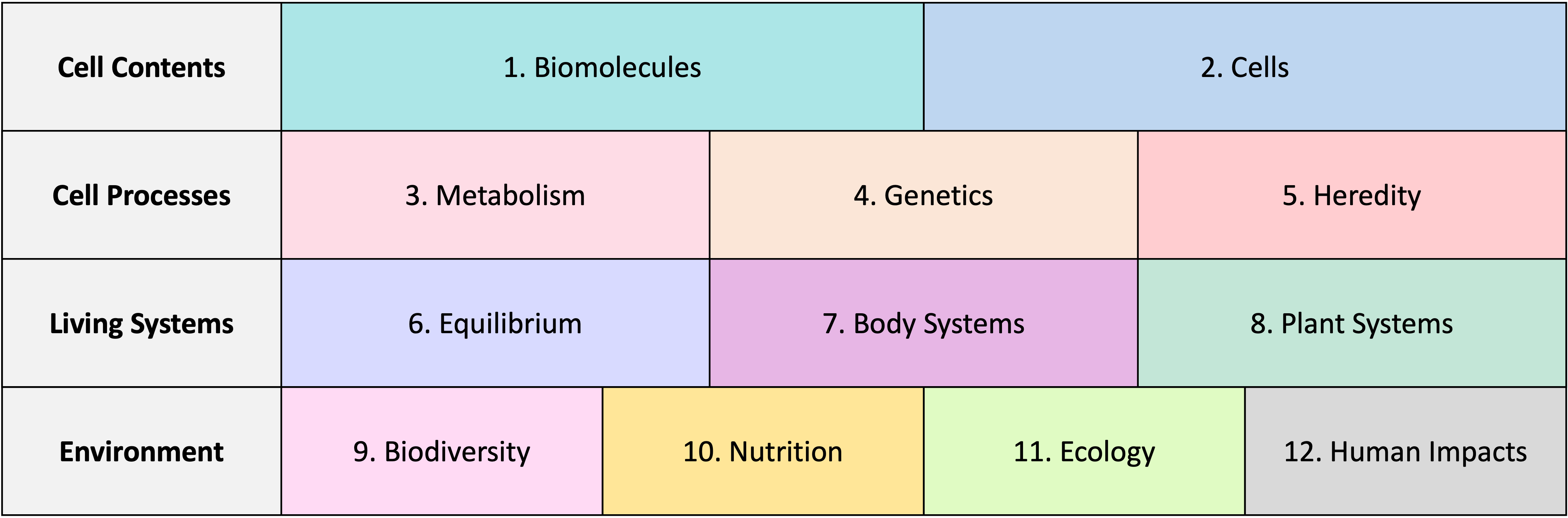
Topics Syllabus
